
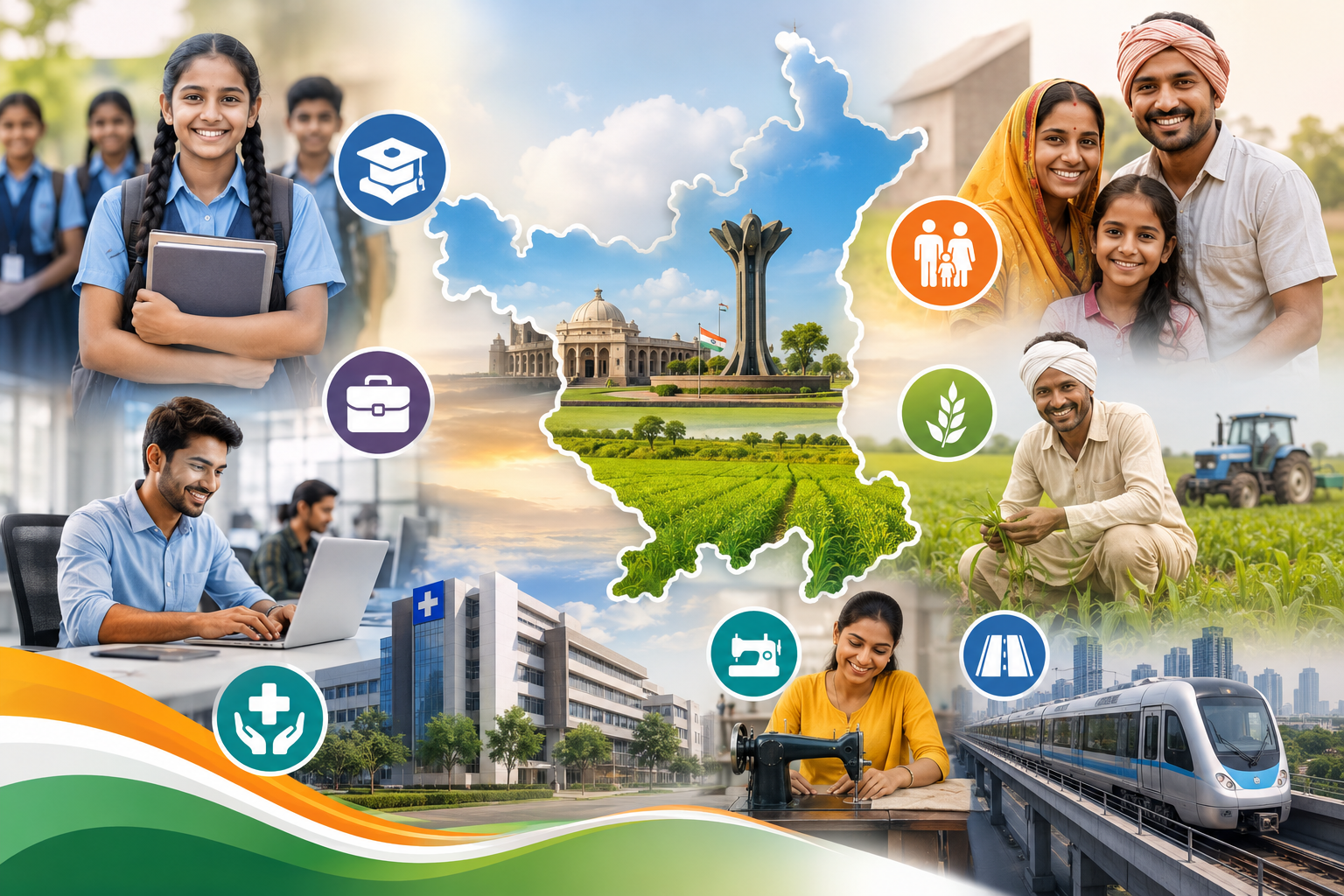
The Haryana government under Chief Minister Nayab Singh Saini has rolled out an ambitious slate of welfare programs and policy reforms in 2026. With a record budget of ₹2.23 lakh crore for 2026–27, a 10.28% increase over the previous year, the state is channeling significant resources into agriculture, education, women empowerment, healthcare, clean energy, youth employment, and industrial growth.
The Haryana Government continues to introduce and strengthen various welfare schemes to improve the lives of citizens across the state. From agriculture and education to healthcare, employment, housing, environment policies and women empowerment, these initiatives are designed to promote inclusive growth and economic development. Understanding the eligibility criteria, benefits, and application process of these schemes can help residents take full advantage of the opportunities available in 2026.
- Agriculture & Farmer Welfare Schemes
Agriculture remains the backbone of Haryana’s economy, and the 2026 budget has given the sector major policy attention.
- Mera Pani Meri Virasat Scheme: One of Haryana’s flagship programmes, this scheme incentivises water conservation and crop diversification. In the 2026–27 budget, the bonus for farmers shifting away from paddy cultivation has been enhanced by ₹2,000 per acre, making it more financially attractive for farmers to adopt water-saving crops.
- Haryana Agri Discom: A landmark announcement from the 2026–27 budget, the Haryana Agri Discom is a dedicated electricity distribution company created exclusively for farmers. It aims to provide uninterrupted power supply to over 7 lakh agricultural consumers across 5,084 feeders — directly addressing the long-standing problem of erratic farm power.
- Cotton Cultivation Incentive Enhancement
The cotton incentive under crop promotion schemes has been raised from ₹3,000 to ₹4,000 per acre, encouraging farmers in districts like Sirsa, Fatehabad, and Hisar to expand cotton area and diversify away from paddy.
- Haryana Fasal Suraksha Yojana
This crop insurance scheme protects farmers from losses arising out of natural calamities, unseasonal rains, floods, or pest attacks. Eligible farmers can register through their nearest Common Service Centre (CSC) or the agriculture department portal.
- Agriculture Machinery Subsidy Scheme
The state provides up to 50% subsidy on the purchase of modern farm equipment for crop residue management, helping farmers avoid stubble burning while mechanising their operations. Group purchases and SC-category farmers receive special priority.
- Promotion of Crop Diversification
Financial and technical support is offered to farmers willing to shift from traditional monocultures to high-value crops such as vegetables, oilseeds, pulses, and horticulture produce, thereby enhancing farm income.
- Education Schemes
- E-Adhigam Scheme: Under this initiative, the Haryana government provides tablets loaded with digital learning resources to students in government schools, narrowing the digital divide and supporting access to quality education in rural and semi-urban areas.
- Haryana Super 100 Scheme: This highly popular scheme offers free coaching to meritorious students in Classes 11 and 12 for competitive examinations such as JEE (engineering) and NEET (medical). Selection is based on a merit examination conducted by the government. The scheme aims to give talented students from economically weaker backgrounds a level playing field.
- Haryana State Merit Scholarship for Undergraduate Girls
Female undergraduate students demonstrating academic merit receive state scholarships to support their higher education costs, reducing dropout rates and encouraging women to pursue professional and technical degrees.
- Consolidated Stipend Scheme for SC Students
Scheduled Caste students pursuing higher education in government colleges receive consolidated stipends, enabling them to sustain themselves financially during their studies without bearing a heavy economic burden on their families.
- Haryana State Meritorious Incentive Scheme
Students who secure the first position in CBSE annual examinations at the state level are recognised and rewarded under this scheme, motivating academic excellence across government schools.
- Women Empowerment Schemes
- Pink Cab Scheme
A newly announced scheme providing interest-free loans of up to ₹10 lakh to women for purchasing electric vehicle (EV) taxis. This initiative simultaneously empowers women economically and promotes green urban mobility.
- Lado Sakhi Yojana
Launched in mid-2025 and continuing into 2026, this scheme is specifically designed for pregnant women. It aims to improve maternal health and nutrition, promote institutional deliveries, and support the welfare of the girl child from birth.
- Mahila Sanskritik Kendra
The government is establishing Mahila Sanskritik Kendras (Women’s Cultural Centres) in every village across Haryana. These centres serve dual purposes, preserving the state’s folk traditions and providing rural women with spaces for learning, arts, skill development, and self-reliance.
- Swasth Nari Clinics
Dedicated women’s health clinics are being established in every district hospital to provide accessible gynaecological and preventive healthcare services to women, with a focus on underserved populations.
- Working Women Hostels
Safe, affordable accommodation facilities for working women are being developed in major employment hubs, Gurugram, Faridabad, Panipat, and Panchkula, to support women who migrate for work and reduce safety concerns.
- Nutrition Kits for Pregnant & Lactating Women
Pregnant and lactating women enrolled in health programmes receive nutritional support kits to combat anaemia and malnutrition, which remain significant concerns in certain districts.
- HPV Vaccination Drive
The state government has committed to administering HPV (Human Papillomavirus) vaccination to 3 lakh girls aged 14 years to prevent cervical cancer, a preventive health initiative with long-term public health significance.
- Health Schemes
- Ayushman Bharat – Haryana Health Protection Scheme
This scheme extends health insurance coverage to eligible families for secondary and tertiary hospitalisation. It ensures that families below a certain income threshold do not face catastrophic out-of-pocket expenses during medical emergencies.
- National Health Mission (NHM) – Haryana
Operating in alignment with the central government’s NHM, Haryana focuses on reducing maternal and infant mortality, expanding immunisation, and strengthening the public health infrastructure in rural areas.
- Mid-Day Meal Scheme
Nutritious meals are served to children enrolled in government schools, improving child nutrition and reducing school dropout rates, particularly among girls and children from low-income households.
- Employment & Youth Schemes
- Haryana AI Mission
One of the boldest announcements in the 2026–27 budget, this mission aims to train 1 lakh (100,000) youth in artificial intelligence, coding, and machine learning. The objective is to prepare Haryana’s workforce for the technology economy and create a talent pipeline that can serve both domestic and global technology firms.
- Saksham Yuva Programme
This established scheme provides monthly stipends and employment assistance to educated unemployed youth in Haryana, with a focus on skill development and job placement.
- Saksham Fund (₹500 Crore)
The newly created ₹500 crore Saksham Fund is earmarked for improving infrastructure in older industrial areas and supporting Micro, Small, and Medium Enterprises (MSMEs), thereby generating employment opportunities at the grassroots level.
- Industrial & Business Schemes
- Make in Haryana Industrial Policy 2026
This is a dedicated five-year industrial policy exclusively for large enterprises and mega projects, launched in 2026. It marks a structural shift from the earlier combined policy (Haryana Enterprise Promotion Policy), which clubbed MSME and large-scale industries together. The new policy aims to attract ₹5 lakh crore in investment and create 10 lakh jobs.
Key features include:
- Capital subsidy for new manufacturing units
- Employment generation subsidy
- Stamp duty exemptions
- Support for Global Capability Centres (GCCs) and data centres
- Incentives for logistics and warehouse businesses
The state has already seen ₹30,000 crore in foreign direct investment (FDI) and MoUs worth ₹1.10 lakh crore signed in the early phases of this initiative.
- GCC & Data Centre Policy 2026
Haryana is positioning itself as a hub for Global Capability Centres and data centre operations. Non-transit-oriented development (non-TOD) zones in Gurugram are receiving priority investment status under this policy.
- MSME Support Schemes
Smaller businesses continue to receive support through capital subsidy schemes, technology acquisition assistance, and the newly established Saksham Fund for infrastructure in old industrial areas.
- Clean Energy Schemes
- PM Surya Ghar: Muft Bijli Yojana (State Implementation)
Haryana has set a target of 2.2 lakh rooftop solar installations by the financial year 2026–27. The state offers dual subsidies:
- Central Financial Assistance (CFA): Directly transferred to consumer bank accounts within 15 days of installation approval
- State Financial Assistance (SFA): Available for 1 lakh Antyodaya (poorest) families on a first-come-first-served basis
As of 2026, over 30,000 installations have already been completed, and the government is working on booster schemes to accelerate the rollout — particularly in rural areas.
- Solarisation of Government Buildings
All government buildings in Haryana are being solarised by December 31, 2026, without drawing on Central Financial Assistance. Surveys have already covered 4,523 government structures with a combined solar potential of 122 MW.
- Social Welfare Schemes
- Old Age Samman Allowance
Senior citizens above 60 years of age receive a monthly financial allowance under this scheme, providing economic security to elderly individuals who may lack pension or other income sources.
- Widow Pension Scheme
Financial assistance is extended to widows across Haryana to help them meet basic expenses and sustain their households, reducing vulnerability among one of the most marginalised segments of the population.
- Scheduled Caste & Backward Class Welfare Schemes
The Directorate of Welfare of Scheduled Castes & Backward Classes administers multiple schemes covering educational scholarships, self-employment support, and social development programmes.
- Ration Card & Food Security
BPL and APL ration card holders continue to receive subsidised foodgrains under the National Food Security Act. The DBT (Direct Benefit Transfer) Haryana portal is the primary platform for accessing entitlements.
How to Apply for Haryana Government Schemes
Most Haryana government schemes can be accessed through the following official channels:
- Antyodaya Saral Portal (saralharyana.gov.in) — Single-window platform for 500+ services and schemes
- DBT Haryana Portal (dbtharyana.gov.in) — For direct benefit transfers and subsidy applications
- Common Service Centres (CSCs) — Available in every block for offline-assisted applications
- Respective Department Portals — Agriculture, Education, Women & Child Development, Health, and Industries departments each maintain their own portals
Recipients are advised to keep their Aadhaar card, bank account details linked to Aadhaar, family ID (Parivar Pehchaan Patra), and income certificate ready before applying.
Conclusion
The Haryana government’s schemes in 2026 reflect a broad, multi-sector vision for inclusive development, from the Agri Discom powering farm fields and the AI Mission skilling youth, to the Pink Cab Scheme empowering women and the Make in Haryana Policy attracting global investors.
Every resident, whether a farmer, student, entrepreneur, or senior citizen, is encouraged to explore the State DBT Portal and other official portals to access the benefits they are entitled to, as Haryana marches toward its goal of a ₹1 trillion economy by 2047.