
AC Installation Tips: Roof, wall, or ground? Learn the best and safest place to hang your outdoor AC unit.
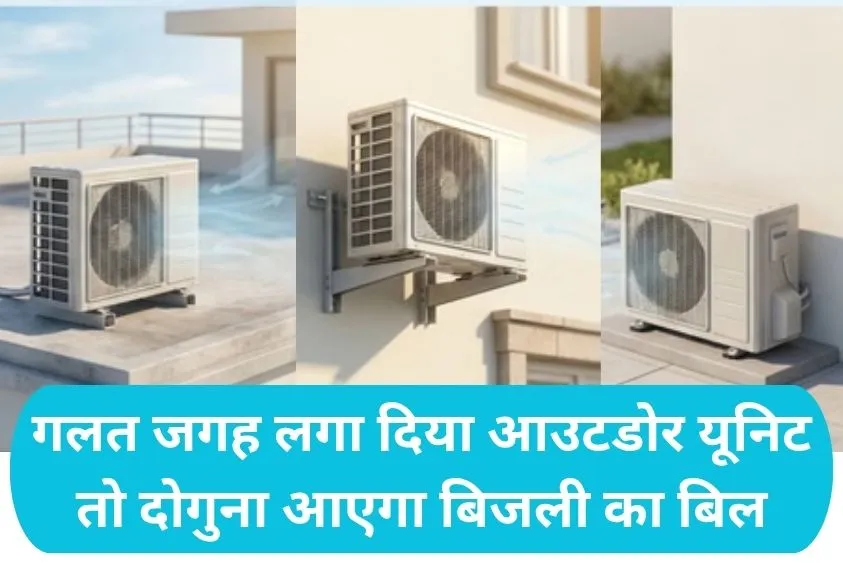

Technology. With the scorching sun, the air conditioner (AC) market heats up across the country. To get relief from the humidity and scorching heat, people rush to buy a new AC, but the real test comes when it comes to installing it. Usually, our focus is on which wall the indoor unit will be placed on so that air flows directly to the bed or sofa. But in this rush, we unknowingly overlook the most important part that makes the entire AC work—the outdoor unit.
According to technical experts, even a small mistake in installing the outdoor unit can ruin both your budget and your comfort. If it’s installed in the wrong direction or in a confined space, it not only drastically increases electricity consumption but also slows down the room’s cooling. Let’s understand which location—the ceiling, the wall, or the ground—is best for the heart of your AC (the compressor).
Open rooftop: Excellent ventilation, but sun exposure is a risk.
If you live on an independent house or the upper floor of a building, the rooftop is the preferred choice for an outdoor unit. An open rooftop provides adequate ventilation to the machine, allowing the hot air from the condenser to escape freely into the atmosphere. This has the advantage of preventing the machine from overheating.
Caution: While there’s no shortage of space on a rooftop, direct sunlight is the biggest enemy. When the scorching sun of May and June shines directly on the iron body, the compressor must work twice as hard to prevent tripping. Therefore, if placing the unit on a rooftop, be sure to construct a small fiber or tin shade over it to ensure ventilation and protect it from direct sunlight.
Wall Mounting: A boon for flats, but ventilation is essential
Nowadays, the most common method in apartment and flat cultures is to hang the outdoor unit using sturdy iron brackets on the wall. Its biggest advantage is that it doesn’t take up your balcony or floor space. Furthermore, the reduced distance between the indoor and outdoor units also saves the cost of copper piping.
Caution: Many people, in an effort to save space, cram the outdoor unit into a very narrow shaft, a narrow duct, or a covered balcony. This is a big mistake. If there isn’t enough space in front of the wall, the warm air coming out of the unit will bounce back into it. As a result, the AC will shut off the compressor after providing cool air for a short time.
Ground Level: Easiest, but most risky
Some homes and offices simply place the outdoor unit directly in the courtyard or backyard to avoid hassles. This location is the easiest for mechanical servicing, but it’s the weakest point in terms of security.
Caution: By keeping it on the ground, lawn dust, flying dry leaves and rain mud get stuck directly in the fan and mesh of the machine. Apart from this, if there is water logging during rainy days, there is a high risk of short circuit or rusting in the lower part. Experts strongly advise that if due to compulsion the unit has to be kept on the ground, then instead of keeping it directly on the floor, get it fixed on a concrete platform or a high iron stand of at least one to one and a half feet high.